


‘The Fact That It’s Happening Shouldn’t Be a Surprise’: CounterSpin interview with Ari Paul on genocide in Gaza
Description
Janine Jackson interviewed FAIR contributor Ari Paul about genocide in Gaza for the August 1, 2025, episode of CounterSpin. This is a lightly edited transcript.
Janine Jackson: The International Rescue Committee, among other groups, is declaring that Israel’s starvation of Gaza has reached a “tipping point”: “The window to prevent mass death is rapidly closing, and for many, it’s already too late.” Famine historian Alex de Waal describes Israel’s food distribution sites as “not just death traps…[but] an alibi.”
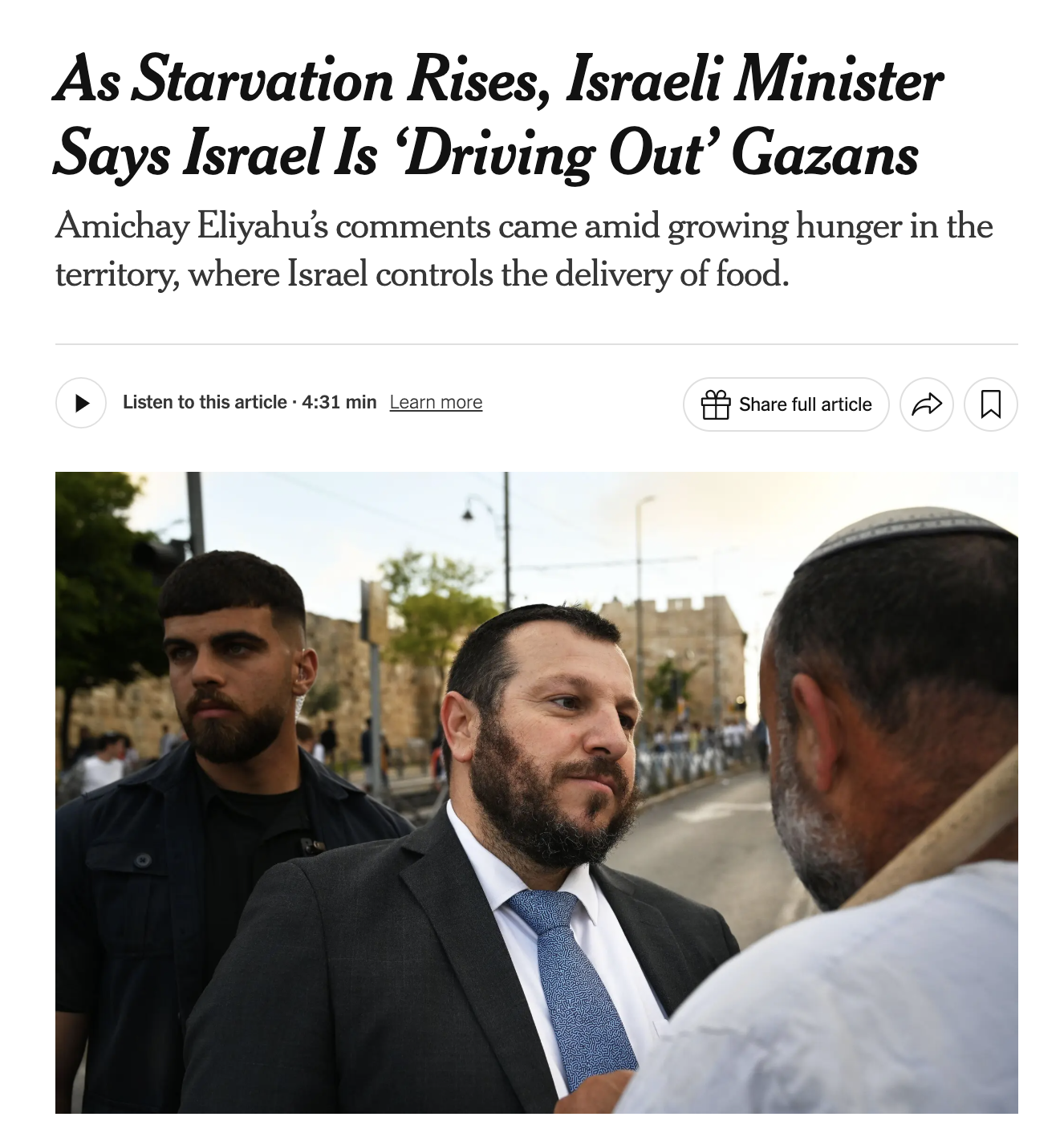
New York Times, 7/24/25
Meanwhile, the New York Times describes Israeli soldiers killing Palestinians trying to access those food sites “a crude form of crowd control.” The epic horror of Israel’s genocide in Gaza has been abetted at every turn by a US press corps too compromised, corrupt and complicit to mount a serious defense of basic human rights or international law. In the face of overwhelming public disapproval, and Senate Democrats trying and failing to block weapons sales to Israel, will anything in media coverage change? And will that matter? Joining us now is independent reporter and frequent FAIR.org contributor, Ari Paul. Welcome to CounterSpin, Ari Paul.
Ari Paul: Thanks for having me.
JJ: We could start anywhere, but you have just written about the recent increase in the use of the word “genocide” in some elite outlets’ reporting. How meaningful is that in the scale of things in July 2025, do you think?
AP: I think it’s been very frustrating for people who have been sounding the alarm ever since October of 2023. It’s been very clear in a lot of Israel’s public statements, from public officials and army officials, military officials, in the press that there’s certainly genocidal intent, or an intent to commit horrific war crimes, throughout Gaza. And I think, seeing over the years, the destruction of hospitals, the destruction of educational facilities, the inability to function as a society, not just bombing sites, but making it an impossible place to live, the type of humanitarian crisis that isn’t just a humanitarian crisis; it reaches the level of worry that we’re reaching a genocidal moment.
And activists all over the world have been sounding the alarm about this. And so when it’s seen now, I think there is some sliver of hope, for people who care about what’s happening in Gaza, that this might bring about some sort of end to it, but given the horrific slaughter of people, the starvation, and just the fact that a once-functioning society has now been reduced to rubble, it feels a little too late for a lot of people watching this.
JJ: Right. And it’s kind of uncanny to hear media suggesting that now people are starting to say this might be a genocide. It is just a kind of blithe, rhetorical erasure of those people who’ve been saying this for a while, and who media have marginalized and worse, all along. But the idea is: now it’s real, because important people are saying it might be real.
AP: Yeah, I think one thing that a lot of people who have been worried about the Gaza situation have pointed out is that it’s very reminiscent of what Nigeria had done to Biafra several decades ago, that they had surrounded this area, that they had the military upper hand, but also kept food out of going into this area, which caused mass starvation. Now, this incident in Biafra had been, for the Western world, this moment where everyone kind of dropped what they were doing and said, ”Oh my gosh, this is just horrible. How could anything like this happen?”
And that, given the control that Israel has always had over Gaza, the potential for just shutting everything off and just letting it die, while raining missiles and conducting raids, was just always so obviously there, that from day one, when this started two years ago, it’s just been impossible to ignore the catastrophe that was waiting to happen, especially when you had people all throughout the Israeli government saying things like that they wanted another Nakba, that they wanted to destroy Gaza, that no one is innocent, things like this.
These are the things that were said in places like Rwanda or Bosnia before the worst things happened. And so I think there were a lot of people on the activist left, the pro-Palestine community, who were taunted as, at best, catastrophists or, at worst, they were derided as antisemitic, blood libel. But the fact of the matter is that these were predictions that were all too real, and now we’re looking at it.
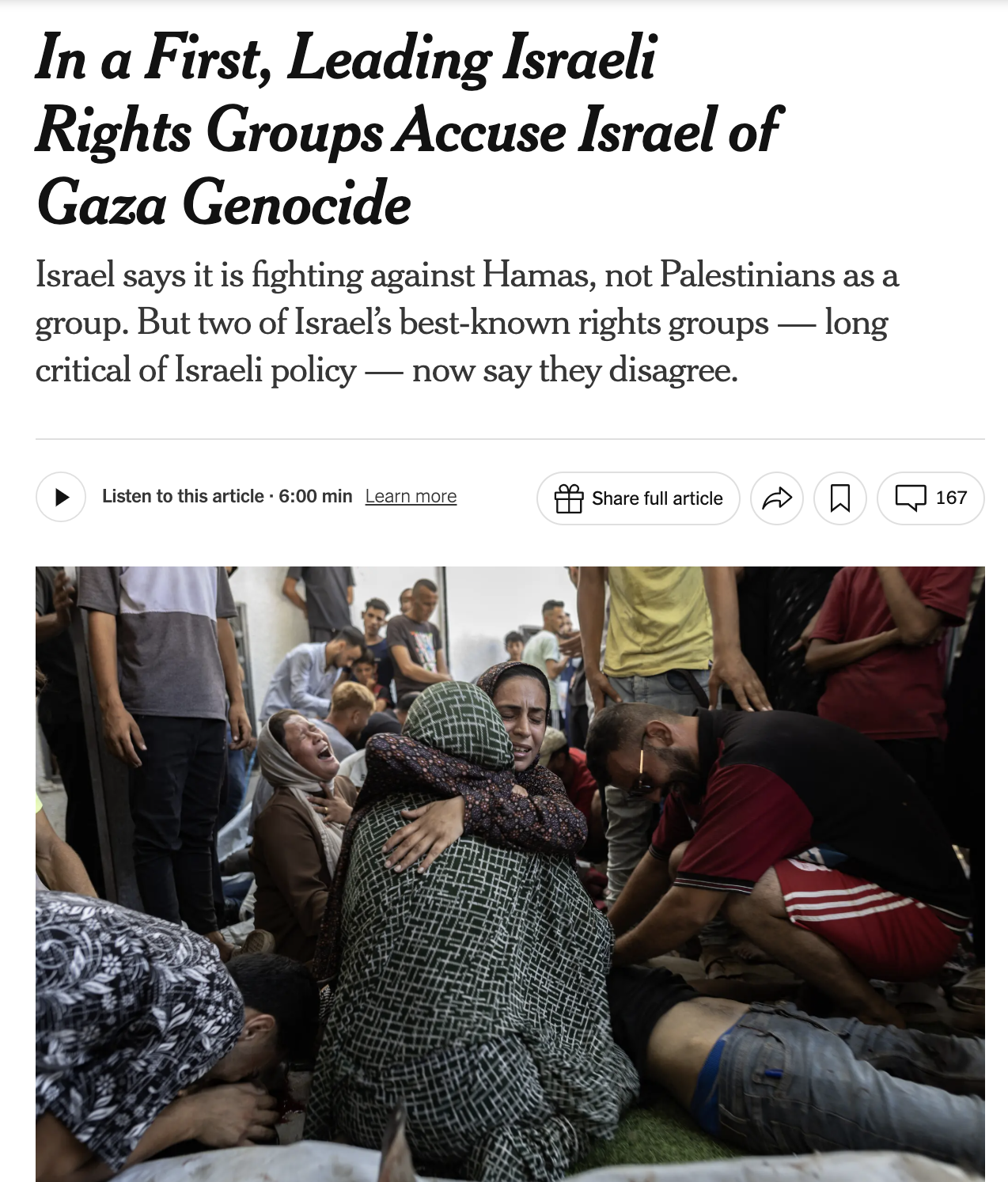
New York Times, 7/28/25
JJ: I was struck by a line in a New York Times report from July 29 that was “Leading Israeli Rights Groups Accuse Israel of Committing Genocide in Gaza.” First of all, I know a lot of listeners will know that you can get a lot more critical information about Israel in the Israeli media than you can here, on many occasions. But I was struck by a line in that piece that said that statements from these rights groups are “adding fuel to a passionately fought international debate over whether the death and destruction there have crossed a moral red line.”
So let’s just take a breath and acknowledge the idea that death and destruction can be ok…except up until some indeterminate point they cross a moral red line. I just found it such a weird construction.
And then it also doesn’t even say what happens once that line is crossed. It’s as though, for media, it’s all just shadows on the cave wall. It’s all just a story, and not a reality.
AP: Yeah, I think one of the problems is that Israel, and those who support what Israel, have been very successful in framing this all as, well, there’s a legitimate goal here to destroy Hamas, that Hamas started this all on October 7, that it’s a terrorist organization, and it’s authoritarian, and it must be eradicated in the same way that many wars are justified, that the Vietnam War kept being justified in the pursuit of destroying the Vietnamese insurgency. So that’s all there, as a kind of “this is the legitimate goal, and all these things are awful. All these things are happening, and they’re awful. But the goal is still important.” And this sort of legitimizes what Israel is doing in Gaza.
But by all accounts, the effort to destroy Hamas has been futile, the actual military gains that the Israelis have made are small or almo


 United States
